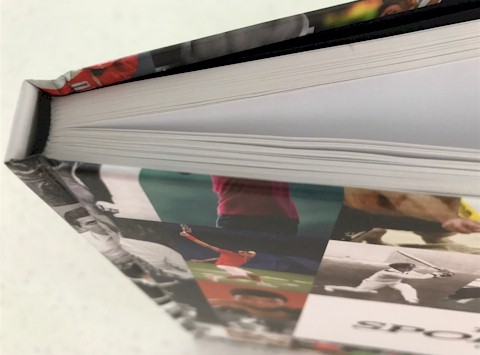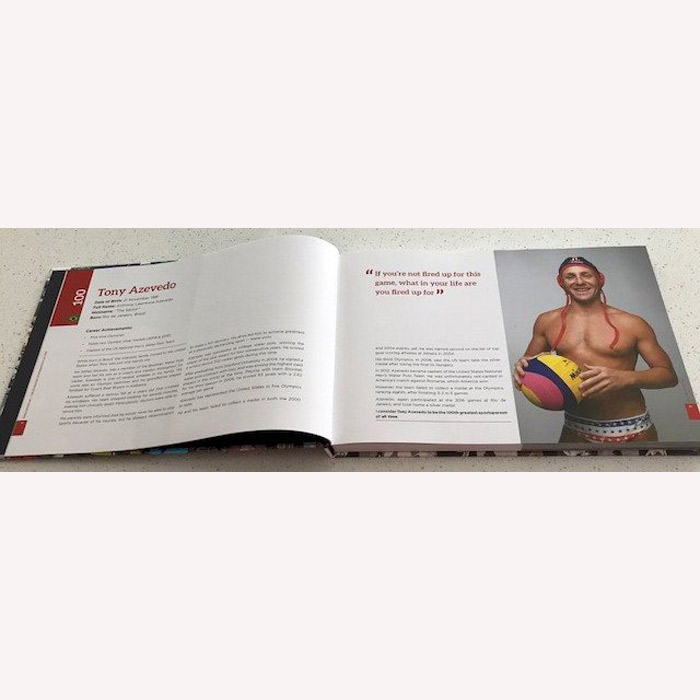
We are thrilled to deliver the final product of a wonderful hardcover book printing project, celebrating incredible sportspeople and their achievements. For example, did you know that Ayrton Senna donated 400 million dollars to help alleviate poverty in Brazil? The 100 Greatest Sportspeople of all Time contains hundreds of amazing facts about some truly inspiring people.
The author, Martin Dreyer, an accomplished sportsman himself, had the vision to write this book so we could all share in the many accomplishments of people dedicated to their sport and other goals.
It was with pleasure for us, Tonia Hill from Crisp Graphics and Maria Chapman (MC2 print brokers) to assist with the production and print of the book. The end result: what a fantastic read!
The book can be purchased online here.
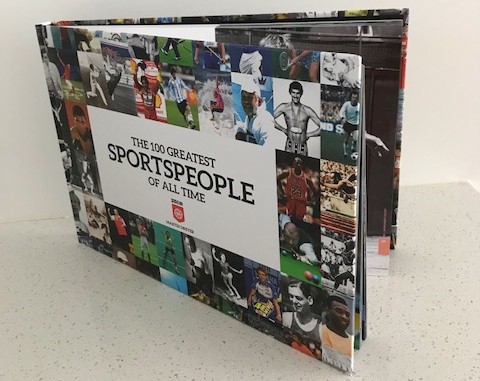
It’s always great when a book print client posts a client testimonial thank you to their social media. I used one of our printers in China for cost effectiveness and quality production. This book was a lot of fun to read and it was my pleasure to help get it printed. Maria Chapman, Director, MC2 Limited.
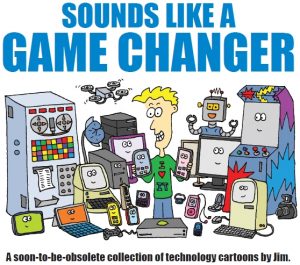
One year ago today, I realised a long worked-for dream of releasing a collection of my technology themed cartoons, called ‘Sounds Like a Game Changer’. That book certainly was a game-changer for Jim and has led to a wave of new cartooning opportunities that are still unfolding today. I will always be grateful to the hundreds of supporters who helped bring it to life through the crowd-funding campaign, and the individuals who helped shape it finally into the publication I wanted it to be. (I’m thinking especially of you here Michelle Dickinson, Maria Chapman and Julian A Waters!) You can still order it online, so please do so if you haven’t already!
Vehicle Graphics Signage
This is one of our latest vehicle graphics signage projects, for a client needing to advertise their company and services.
Do you need assistance with a vehicle wrap or a quote? Please contact us at maria@mc2.co.nz or 021 824 933.
Make your assets work hard for you and reach more customers while you’re on the road. Wrap your vehicles with eye-catching signage and bold branding, so that you stand out while you’re travelling across your city and region.
Effective vehicle signage has fast become the most powerful outdoor advertising medium for your marketing dollar spend. We can help you turn your vehicles into great marketing tools that promote your business, raise your brand profile, and strengthen your brand image.

Our latest label printing job has yielded an incredible result.
Take a look at the most recent label printing result. Printed with a luxurious look and great colour reproduction, our client's products feel great in the hand and look the part too!. Designed by Holistic Hair and printed by MC2. If your business needs labels, contact us.
These products can be purchased online here.
From a publishing perspective, print media includes newspapers, magazines and books. From a marketing and advertising perspective, print media also includes brochures, posters, flyers, directories and direct mail pieces, such as letters and postcards.
From a reader’s perspective, print media is used to gather information or for entertainment purposes. Newspapers are a common source of local, regional or national news. Local magazines or business publications also provide readers with information on topics of interest. Some magazines, along with books, are used for entertainment or pleasure. People read fiction books, for instance, for entertainment driven by a story, plot and characters.
In marketing, companies rely on print media to deliver messages to targeted customers. While readers do not necessarily seek ads in newspaper or magazines, publishers rely on advertising dollars from companies to keep subscription rates low and to generate profit. Advertisers want to engage customers as they read through the pages.
Other print media is specifically developed to convey an advertiser’s message to targeted customers. Companies prepare flyers, posters and brochures to communicate company, product or event-specific information or benefits. These media are often mass-distributed to customers through public postings. Direct mail pieces are sent to targeted customers in their mailboxes.
As marketers’ investments in print advertising continue their steep decline, experts explain the medium’s relevance in the digital age
Last year was another rough one for newspaper and magazine publishers. In 2014, 91 U.S.- and Canada-based magazines ceased publication, up from 51 closures in 2013, while stalwarts like the U.S. political magazine National Journal decreased their issue frequency. On the newspaper end, total ad revenue in 2013 was 49% lower than it had been a decade earlier, according to the "State of the News Media 2014 " study by the Pew Research Ce nter, and Tribune Co. is estimated to have cut 700 jobs in 2013 alone. Fearing for the worst, many publishers are raising subscription costs in an attempt to offset declines in print advertising revenues, investing in flashier digital delivery platforms in order to offer advertisers multichannel bundle opportunities, or launching annual events in the hopes of generating enough money via registrations and sponsorships to sustain a year’s worth of magazine production costs.
But print advertising isn’t dead, experts say. Print circulations are down, but in many cases, that means that publications’ readership has been culled to only the most engaged, which is a desirable trait, from an advertising standpoint. The primary challenge with print is demonstrating the ads’ effectiveness, but experts argue that there’s a solution.
“Print is interesting because it actually provokes people to read it,” says Britt Fero, executive vice president and head of strategy in the Seattle office of New York-based ad agency Publicis. “Just buying it or getting it in the mail provokes the reader to engage in a way that digital doesn’t. If you have time to read a magazine, then you’re going to really engage with the ads in there. Print ads should inspire you to look at them even longer.”
The Pros of Print Advertising
"Print is still a top-of-funnel medium,” says Andy Blau, senior vice president of finance and advertising at New York-based magazine publisher Time Inc. “It’s really for establishing brand worthiness in the marketplace, for establishing the value of the brand, for communicating very broadly, with broad reach, to the right target audience. It’s really pure brand advertising. And digital tries to do some of that, but it’s still much more of a direct response. People still measure digital with click-throughs and conversion rates, and you can’t necessarily maintain marketing of a brand through digital alone. Print advertising is a very efficient way of establishing a brand identity and for communicating that to the target market."
Advertisers have to factor in longer lag times for measuring print ads’ impact, Blau says, but it’s worth it in the end because of print’s longer shelf life and higher potential for reverberations beyond the initial reader. “There are methodologies for proving ROI for print, but it’s not instantaneous like it is with digital for a variety of reasons: It’s a physical product, it takes time to arrive at a person’s house, it’s there for a long time so there are many impressions, and there’s a pass-along and an audience reach that accumulates over at least two weeks.” In other words, patience is required, but it’s possible that a print ad’s value extends well beyond its CPM.
Leave it to a publishing executive to make the case for print advertising, but Fero agrees. “People are in different mental spaces when they choose to engage with a printed magazine versus digital content. Magazines, and print in other forms, serve as inspiration, and they also can be informational. A lot of that is title-dependent and reader-mindset-dependent. What does the reader want to get out of those five minutes that he spends with that particular title? This is really where, in marketing, you can actually add value to a medium because the reader is looking for a very specific kind of content anyway, versus just talking about your brand. Print is becoming even harder, more competitive. It has to speak to the kind of content someone is really interested in.”
Sponsored content or native ads are the trendiest way to serve up publication-specific content in an attempt to engage readers, but print ads also offer such versatility through image selection and messaging cues, Fero says. "There’s a beauty to a lot of magazines, which is why people still engage with them, where the artistic nature of well art-directed, very visually driven communication stands out in that environment. Where print is really excelling, though, is thinking about how you tie to that content directly. … You can use print to tell multiple stories about a brand. A cruise line can be in a food and wine magazine to tell the food story, and a travel magazine to tell stories about the destinations and ports that they have, and can also be in something like Architectural Digest to be able to tell readers about their new ship designs."
Addressing the Cons of Print Advertising
Print might not be as effective for all advertisers, especially those marketing time-sensitive offers, she adds, as the print medium best fits products with longer consideration times, such as the aforementioned cruises, or cars or even CPG goods. “You have to bank on the fact that your product or service doesn’t require immediacy because there’s often a long lag time between publication and people actually reading it.”
Moreover, you’ll likely have to do more legwork to demonstrate the results of your print investment than you would for a digital ad buy—but those results can be worth it. According to a February 2014 study by GfK Panel Services, the arm of the Nuremberg, Germany-based research firm that specializes in ROI studies, magazine and newspapers have the highest ROI, at 125%, compared with other ad mediums including TV and digital, which weigh in at 87%—and that’s ROI in concrete revenue terms. The study, conducted for Dutch news media brand NPD Nieuwsmedia, tracked purchase behavior through online data and questionnaires.
“Over the course of many years, print brands have successfully developed strong connections with their readers,” says Mickey Galin, executive vice president of research and director of business development at GfK’s Mediamark Research and Intelligence group in New York. “Many readers look forward to their time with their print brand. We believe that readers often consider magazines to be their friend and would be unwilling to do without their favorite brands. The overall experience of consuming print brands pairs content with advertising in a seamless way [so that some] readers actually want to see the advertising that’s carried in the [print] brands that they consume.”
Marketers can include QR codes, or set up ad-specific URLs and “vanity sites” so that they can track how much traffic is generated from a particular print ad, and the tried-and-true “How did you find us?” question on a lead gen form still works, as well, says Aaron Padin, head of art and design at J. Walter Thompson New York. Print ads also can be fertile ground for engaging creative that spurs on social buzz, he says. “Good print can spread in a new way since people will tweet about it. They’ll mention it on Facebook,” which means that marketers can leverage social listening platforms for a more well-rounded perspective on a print ad’s performance.
In most ways, ROI from print ads is still very challenging to track directly, and many returns are softer than CEOs want to hear—although marketers should make the case for their worth, Padin says. The real value in print advertising is in brand awareness and perception, and in getting your message or offer to be top of mind in the long run, he says. "Whether the print ad is about driving traffic to a website or simply building brand awareness, I look at whether the brand is moving overall. That’s the biggest, and simplest, success metric."
Long Live Print Advertising
In February 2015, Time Inc. announced that it would expand its current programmatic-buying platform from solely digital ad buys to include digital and print ad bundles. “There’s a misconception among advertisers that print ads are much more expensive than digital, but the gap is much smaller than you would think,” Time Inc.’s Blau says. “We thought that by launching print programmatic, we could expose print to a whole digital buying community that never considers print.”
While one of the goals of this program is to provide more accurate ROI metrics for print publications, that technology is still far from perfect, says Sam Cox, vice president of global media at New York-based MediaMath, the programmatic-buying software provider that built Time’s platform. “The idea is that we can use the tools that we’ve traditionally used for digital closed-loop attribution and start to use them for other forms of media, but that’s going to take a lot of work with audience syncing over the next few years,” he says. “If we, as digital marketers, can think about how to define the ROI, and how to bring some of the values that print has in terms of brand lift, recognition and all of the other brand metrics that are traditionally associated with [an ROI] study that you would do with print, and integrate that into your digital offering, we think that the whole is greater than the sum of its parts.”
Fero warns that if publishers start selling print ad space in the same way that digital ads are sold—by demographic rather than title—they run the risk of marring what makes print ads, especially in magazines, so special: continuity of content. “With print, I have to be interested enough in the totality of the content of a magazine to subscribe to it,” she says. “Online, you can find me alone, looking at me solely through my demographic, but when I’m looking at a magazine, that matters much less. The way people consume print, it just doesn’t work the same way as digital.”
Padin agrees that what continues to make print ads valuable is the (nearly) undivided attention that readers give to magazine and newspaper content, rather than multitasking like they do when consuming digital content. “Print is all about that consumer engagement, where people are physically holding the ad in their hands,” he says. “That’s something I directly tell clients and their C-suites. You want to reach people where they are, and that’s what print is now.”