
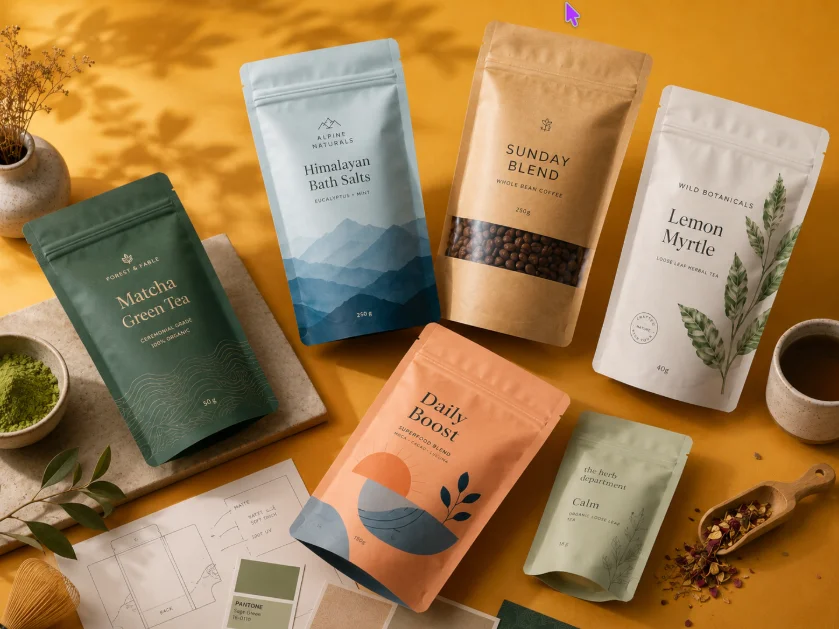
Stand Up Pouches Auckland: The Complete Guide for NZ Brands
Walk down the snack aisle at your local New World or Countdown and you will notice something. The shelf is dominated by flexible, upright packaging that displays product beautifully, seals freshness in, and communicates brand identity without saying a word. Stand up pouches have quietly become one of the most popular packaging formats in the New Zealand food, beverage, and retail market, and Auckland-based brands are leading the charge.
Whether you are launching a new cold brew coffee, a range of locally sourced trail mixes, or a boutique skincare line, stand up pouches Auckland suppliers and print specialists can help you get your product shelf-ready. But before you place an order, there is a lot to understand: materials, finishes, minimum order quantities, food-grade compliance, and design considerations all play a role in the final result.
At MC2, based in Rosedale, Auckland, we work with brands across New Zealand to source, manage, and quality-check custom printed packaging. This guide covers everything you need to know about stand up pouches Auckland, so you can make confident, informed decisions from day one.
Table of Contents
What Are Stand Up Pouches?
Stand up pouches, sometimes called Doypack pouches, are flexible packaging bags with a gusseted base that allows them to stand upright on a shelf without additional support. They were first patented in 1963 by French engineer Louis Doyen, but it is only in the last two decades that they have become a mainstream packaging solution globally, including here in New Zealand.
Their popularity comes down to practicality. Stand up pouches are lightweight, take up less storage space than rigid containers, and offer excellent product visibility when designed well. They are used across a wide range of categories, from coffee and tea to pet food, protein powders, spices, dried fruit, confectionery, liquid products, and even cosmetics.
For Auckland brands competing on supermarket shelves or selling through online retail, stand up pouches offer a professional, scalable packaging option that does not require the same capital investment as rigid or moulded packaging. That makes them particularly attractive for small and medium-sized NZ businesses looking to launch or grow a product range.
Common Types of Stand Up Pouches
There are several formats to be aware of when exploring stand up pouches Auckland options. The most common include pouches with a zip-lock resealable closure, pouches with a tear notch only, and pouches with a spout or nozzle for liquids and semi-liquids.
Window pouches, which feature a clear panel on the front or back, are popular for products where the physical contents add to the appeal, such as colourful sweets or premium loose-leaf tea. Clear pouches, where the entire surface is transparent, are another option for products that speak for themselves visually. Each format suits different product categories, and choosing correctly from the outset will save you both time and cost.
Materials and Finish Options for Stand Up Pouches
The material you choose for your stand up pouch directly affects shelf life, product safety, print quality, and sustainability credentials. This is one of the most important decisions you will make, and it is worth taking the time to understand your options before requesting a quote from any stand up pouches Auckland supplier.
Most stand up pouches are made from laminated film structures, meaning multiple layers of different materials are bonded together to achieve the desired combination of barrier properties, strength, and printability. Common structures include combinations of PET (polyethylene terephthalate), foil (aluminium), and PE (polyethylene), or variations using nylon and BOPP (biaxially oriented polypropylene).
Popular Material Options
A PET/PE structure is a common and cost-effective option suited to dry goods that do not require a high barrier against oxygen or moisture. It is lightweight and provides a good surface for flexographic or digital printing. For products that are sensitive to light, moisture, or oxygen, such as coffee, dried meats, or pharmaceutical goods, a foil laminate structure offers a superior barrier and significantly extends shelf life.
Kraft paper pouches have grown in popularity across the NZ market, driven by consumer demand for more natural-looking, eco-conscious packaging. They work well for artisan food brands, health products, and specialty retail. Compostable and recyclable film options are also now available, though they typically come with higher costs and slightly different printing constraints, so it is worth discussing these with your print manager before committing.
Finish options include matte, gloss, and soft-touch lamination, as well as spot UV, foil stamping, and embossing for premium applications. A matte finish has become particularly popular with premium NZ food brands because it conveys quality and stands out against the sea of glossy competitors on the shelf. Gloss finishes remain popular for value products and categories where vibrancy and colour saturation are the priority.
What NZ Brands Need to Know Before Ordering
Ordering custom printed stand up pouches Auckland is not as simple as uploading a logo and picking a size. There are several practical considerations that can significantly affect the outcome, especially for businesses ordering for the first time.
Minimum order quantities (MOQs) are often the first sticking point for smaller NZ brands. Most offshore manufacturers, who produce the majority of custom printed flexible packaging used in New Zealand, require MOQs of between 3,000 and 10,000 units per SKU. This is because the setup costs for flexographic printing plates and film lamination are spread across the run. Digital printing technologies are beginning to lower MOQs, but they come with trade-offs in colour range and material options.
It is worth having an honest conversation with your print manager about your realistic sales volumes before locking in quantities. Ordering 10,000 pouches of a product that sells 500 units per month ties up cash and storage space unnecessarily. Equally, under-ordering means you will face repeat setup costs sooner than expected.
Food-Grade Compliance in New Zealand
If your stand up pouch will be used for food or beverage products, food-grade compliance is non-negotiable. In New Zealand, food contact materials must comply with the Food Act 2014 and relevant standards, which require that packaging materials do not transfer harmful substances to food under normal conditions of use.
When sourcing stand up pouches Auckland, always request documentation confirming that the materials used are food-grade certified. Reputable manufacturers will provide migration testing certificates and material safety data sheets. This is particularly important if you are exporting to Australia or other markets, where additional compliance requirements may apply under the Australia New Zealand Food Standards Code.
Ink systems used in printing must also be food-safe, with printing on the outer laminate layer rather than in direct contact with the product. A good print broker will know which suppliers reliably meet these standards and will manage compliance documentation on your behalf, removing a layer of complexity from the process.
Lead times are another critical consideration. Custom printed stand up pouches from overseas manufacturers typically take between eight and ten weeks from artwork approval to delivery at your New Zealand address. Factoring in production time, ocean freight, and customs clearance is essential for launch planning. Working with an Auckland-based print manager means someone local is tracking your shipment and managing any delays proactively.
Design Considerations for Custom Printed Pouches
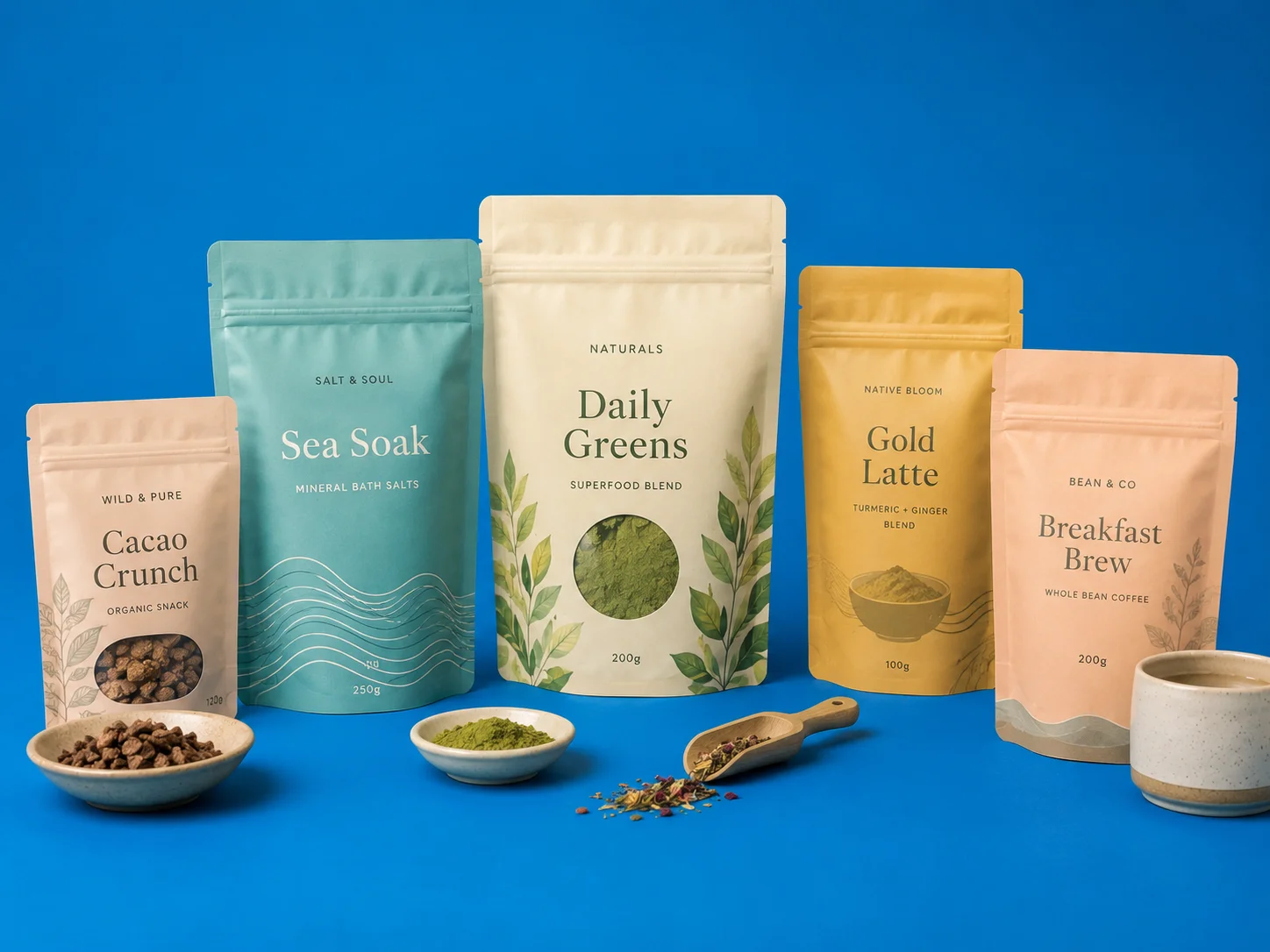
Good packaging design for stand up pouches is both an art and a science. The pouch format has its own set of design constraints that differ from flat labels or rigid packaging, and understanding these early will save costly revisions later.
The most important starting point is obtaining the correct die-line template from your supplier before your designer begins work. A die-line is the technical outline of the pouch, showing the exact printable area, seal zones, zip closure position, and any restricted areas. Placing key design elements too close to a seal zone is one of the most common errors in pouch design, and it can result in important branding or regulatory text being partially obscured or distorted after sealing.
Colour accuracy is another area that requires attention. Stand up pouches are typically printed using flexographic printing with a set number of spot colours, or using CMYK process printing for more complex artwork. Colours on screen often look quite different from colours on a flexo-printed film substrate, particularly for bright neon tones and very light pastel shades. Requesting a physical colour proof or a pre-production sample before committing to a full print run is strongly recommended, especially for brand colours where consistency across your product range is critical.
Regulatory labelling requirements in New Zealand must also be incorporated into the design from the start. Food products must meet the requirements of the Food Information Standard, which mandates nutrition information panels, ingredient lists, allergen declarations, country of origin statements, and other mandatory information. Attempting to fit these into a design retrospectively, after the layout has already been developed, is a frustrating and time-consuming process that is easily avoided with proper planning.
Finally, consider the customer experience. Where does the pouch sit in the usage journey? Does it need to be recloseable after opening? Should it have a hang hole for peg display? Is the tear notch positioned where it is intuitive for a consumer to use? These functional design elements are easy to overlook when focussed on the visual aesthetics, but they directly affect how your customer interacts with your product day to day.
Working With a Local Print Partner in Auckland
Sourcing stand up pouches Auckland through a local print management partner like MC2 offers a fundamentally different experience to going direct to an offshore manufacturer. The difference lies in expertise, accountability, and the ability to manage complexity on your behalf.
At MC2, we have established relationships with specialist flexible packaging manufacturers who meet the quality and compliance standards required for the New Zealand and Australian markets. We manage the full process from brief to delivery, including artwork checks, die-line review, pre-production samples, compliance documentation, production oversight, and freight management. This means you are not navigating unfamiliar territory alone, and there is a local point of contact if anything needs attention.
Much like the way we approach complex print projects such as getting a board game printed in NZ with our complete guide to custom game printing, flexible packaging requires careful supplier selection, technical knowledge, and hands-on quality management throughout the production process. The stakes are high when your product packaging is the first thing a customer sees.
We also work with clients across a diverse range of print categories. For brands who produce both product packaging and printed collateral, we can manage these alongside one another. If you are curious about the breadth of print projects we handle, our experience with children's book printing Auckland: how to bring your story to life in print is a good example of the precision and care we bring to every project, regardless of category.
Working with a local Auckland partner also means faster communication and more responsive problem-solving when issues arise during production. Time zone alignment with a New Zealand-based project manager, rather than communicating with an offshore manufacturer during your off-hours, makes a genuine difference when a decision needs to be made quickly to keep a production run on track.
For brands who are new to custom packaging, our role is also educational. We take the time to explain the options, help you understand the cost drivers, and guide you toward a specification that balances quality, compliance, and budget. If you are also working on other branded print assets, we can help you see the full picture, much as we do when helping clients understand children's book printing Auckland and how print specifications shape the final result.
Frequently Asked Questions
What is the minimum order quantity for stand up pouches Auckland?
Most custom printed stand up pouches Auckland suppliers require a minimum order of between 3,000 and 10,000 units per SKU, depending on the printing method and material specification. Digital printing options may allow lower quantities, though with some limitations on material choices and colour range. Discussing your realistic volume needs upfront with a print manager will help you find the most cost-effective solution.
How long does it take to receive custom printed stand up pouches in Auckland?
Lead times for custom printed stand up pouches Auckland typically range from eight to ten weeks from final artwork approval to delivery in New Zealand. This includes production time, quality inspection, ocean freight, and customs clearance. Planning ahead and allowing a buffer in your launch timeline is strongly recommended to account for any unforeseen delays.
Do stand up pouches need to be food-grade certified for NZ food products?
Yes, stand up pouches used for food or beverage products in New Zealand must be made from food-grade certified materials that comply with the Food Act 2014. Reputable manufacturers will provide migration testing certificates confirming the materials are safe for food contact. Always request this documentation before placing an order for any food packaging application.
What finishes are available for custom printed stand up pouches Auckland?
Common finish options for stand up pouches Auckland include matte lamination, gloss lamination, soft-touch lamination, spot UV, foil stamping, and embossing. Matte finishes are particularly popular with premium NZ food and health brands for their sophisticated appearance. Your choice of finish should align with your brand positioning and the substrate material you have selected.
Can MC2 manage the full sourcing and production process for stand up pouches in Auckland?
Yes, MC2 manages the entire process for stand up pouches Auckland clients, from initial brief and supplier selection through to artwork review, pre-production sampling, compliance documentation, production oversight, and delivery to your Auckland address. Having a local print manager handle this process removes complexity and provides a single point of accountability throughout the project.
Final Thoughts
Stand up pouches have become a cornerstone of modern product packaging in New Zealand, and for good reason. They are versatile, professional, cost-effective at scale, and highly effective at communicating brand identity on a crowded shelf. But getting them right requires more than selecting a size and uploading a logo.
For Auckland brands, working with a local print partner who understands the technical, compliance, and logistical dimensions of flexible packaging means fewer surprises and better outcomes. At MC2, we bring the same precision and accountability to stand up pouches Auckland that we bring to every print project we manage, from initial consultation through to final delivery.
If you are ready to explore custom printed stand up pouches for your NZ brand, or if you simply want to ask a few questions before committing, we would love to hear from you.
MC2 Print, 28 Constellation Drive, Rosedale, Auckland
Email: maria@mc2.co.nz | Phone: 021 824 933